
Helena Pahava
Esthetic Academy

PDF Downloads
Explore facial anatomy in detail to master safe, effective techniques and elevate your esthetic practice.

Skin Penetration Routes
Skin Penetration Routes
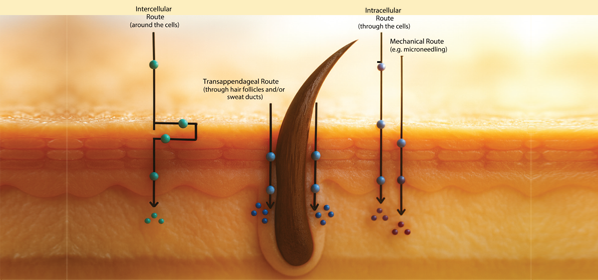
Our skin acts as a barrier, but active ingredients can still enter through different pathways. The effectiveness depends not only on the route but also on what supports or enhances absorption.
• Intercellular Route (around the cells) This is the most common pathway, weaving through the lipid layers between skin cells. What helps: Ingredients formulated with lipid-loving carriers (like ceramides, fatty acids, phospholipids, and liposomes) and small molecular weight actives (retinol, vitamin C derivatives, peptides).
• Trans appendageal Route (via hair follicles and sweat ducts) Products can bypass the stratum corneum and move down hair shafts or sweat ducts. What helps: Exfoliation and cleansing to keep follicles open, plus nanoparticles or emulsions that target follicular delivery.
• Intracellular Route (through the cells themselves) Molecules pass directly through keratinocytes, entering from cell to cell. What helps: Hydration (humectants like hyaluronic acid increase cell permeability), small, water-soluble molecules, and formulations designed for cellular entry.
• Mechanical Route (e.g., microneedling, dermarollers, laser channels) Physical methods create micro-channels in the skin for deeper penetration. What helps: Professional treatments like microneedling, laser resurfacing, ultrasound, or iontophoresis paired with active serums these push ingredients past the skin’s natural barrier.
Practical tip for estheticians:
Always apply serums and actives right after lymphatic drainage or exfoliation when the skin is warm, circulation is increased, and the barrier is more receptive. This maximizes penetration and results.
Skin Penetration Routes
Skin Penetration Routes
Our skin acts as a barrier, but active ingredients can still enter through different pathways. The effectiveness depends not only on the route but also on what supports or enhances absorption.
• Intercellular Route (around the cells) This is the most common pathway, weaving through the lipid layers between skin cells. What helps: Ingredients formulated with lipid-loving carriers (like ceramides, fatty acids, phospholipids, and liposomes) and small molecular weight actives (retinol, vitamin C derivatives, peptides).
• Trans appendageal Route (via hair follicles and sweat ducts) Products can bypass the stratum corneum and move down hair shafts or sweat ducts. What helps: Exfoliation and cleansing to keep follicles open, plus nanoparticles or emulsions that target follicular delivery.
• Intracellular Route (through the cells themselves) Molecules pass directly through keratinocytes, entering from cell to cell. What helps: Hydration (humectants like hyaluronic acid increase cell permeability), small, water-soluble molecules, and formulations designed for cellular entry.
• Mechanical Route (e.g., microneedling, dermarollers, laser channels) Physical methods create micro-channels in the skin for deeper penetration. What helps: Professional treatments like microneedling, laser resurfacing, ultrasound, or iontophoresis paired with active serums these push ingredients past the skin’s natural barrier.
Practical tip for estheticians:
Always apply serums and actives right after lymphatic drainage or exfoliation when the skin is warm, circulation is increased, and the barrier is more receptive. This maximizes penetration and results.
Skin Barrier
Our skin acts as a barrier, but active ingredients can still enter through different pathways. The effectiveness depends not only on the route but also on what supports or enhances absorption.
The skin barrier also called the stratum corneum is made up of tightly packed skin cells (corneocytes) surrounded by a layer of lipids (ceramides, cholesterol, and fatty acids). Think of it as a brick-and-mortar wall:
• The cells are the bricks.
• The lipids are the mortar that seals and protects everything in place.
When this structure is intact, your skin barrier keeps moisture in and irritants out, maintaining a smooth, hydrated, and resilient complexion.
However, when the barrier is disrupted through over-exfoliation, aggressive peels, harsh cleansers, or environmental stress small gaps appear between the cells. This allows:
• Water to escape (causing dehydration and tightness)
• Irritants, bacteria, and pollution to enter (causing sensitivity, redness, and inflammation)
A compromised barrier doesn’t just affect the surface; it interferes with lymphatic flow, skin immunity, and cellular communication, leading to premature aging and dullness.
To restore balance, focus on repair, not stripping: Gentle cleansing Balanced pH Lipid-rich products (ceramides, cholesterol, and fatty acids) Calming ingredients like niacinamide and panthenol Adequate hydration and healthy fats in the diet
Remember:
Healthy skin is not the result of constant exfoliation it’s the result of a strong, functional barrier that can defend, renew, and heal itself.
How Water Increases permeability
Our skin barrier made of skin cells (corneocytes) surrounded by lipids (ceramides, cholesterol, and fatty acids) is constantly changing depending on hydration levels. The amount of water within the stratum corneum affects how easily substances can pass through it.
Dry Skin
When skin is dry, its lipid “mortar” is dense and tightly packed. This creates a strong barrier that limits water loss and prevents irritants from entering. That’s why applying active ingredients such as retinol or acids on dry skin allows for slower, more controlled absorption, reducing irritation risk.
Damp Skin
After cleansing or misting, skin cells absorb water and swell slightly. This swelling loosens the lipid matrix, creating small gaps that increase permeability. While this can enhance product penetration, it can also make skin more sensitive. That’s why it’s better to avoid strong actives (like retinol or acids) on damp skin the barrier is temporarily more open and reactive.
Occluded Skin
When skin is covered (for example, with a thick cream, balm, or mask), water retention increases, and the lipids soften further. This can again cause microscopic gaps and greater absorption of ingredients beneficial for soothing or repairing products, but risky for potent actives. Therefore, occlusion works best with barrier-supportive treatments, not exfoliating or irritating products.
Key Lesson:
The skin’s permeability isn’t static it changes with moisture levels. Understanding these shifts helps estheticians time treatments correctly and protect the barrier during active ingredient use.
Damp Skin vs Dry Skin
When we apply products, the skin’s moisture level matters a lot. Damp skin is more permeable, which means it allows ingredients to go in deeper. That can be very helpful for hydration — but not always safe for strong actives.
Hydrating ingredients like hyaluronic acid, ceramides, and other moisture-binding ingredients love damp skin. They lock the water inside and help rebuild the barrier. That’s why, after cleansing or misting, it’s great to apply your hydrating products right away, before the skin dries completely.
But when it comes to stronger ingredients retinol, AHAs, BHAs, benzoyl peroxide, azelaic acid, or prescription medications the skin should be completely dry. Damp skin would let them penetrate too deeply and cause irritation or redness.
Vitamin C in its pure form (ascorbic acid) also works best on dry skin, while vitamin C derivatives are gentler and can be applied on either damp or dry skin, depending on skin sensitivity. So, remember this: Hydrating products go on damp skin to seal in moisture. Active ingredients go on dry skin for safety and control.
Understanding this simple difference helps you apply products correctly and protect the skin barrier every time.
How Your Skin Protects Itself
Your skin is your body’s first line of defense a living, intelligent barrier that protects you every day. Let’s look at how this protective system works:
1. Acid Mantle The acid mantle is a thin, invisible film made of sweat and sebum that covers the surface of the skin. It maintains a slightly acidic pH (around 4.7 to 5.6) to keep the skin balanced. This acidity helps prevent harmful bacteria from growing while supporting healthy flora. When the acid mantle is disrupted for example, by harsh cleansers or over-exfoliation the skin becomes vulnerable to irritation, dryness, and breakouts.
2. Skin Microbiome On top of your skin lives a community of beneficial microorganisms the microbiome. It includes normal flora, bacteria, fungi, and even viruses that coexist in balance. This ecosystem helps protect against harmful pathogens and maintains healthy skin function. When the microbiome is disturbed, the skin can experience inflammation, sensitivity, and dehydration.
3. Immune Cells Deeper in the layers of the skin, immune cells act as sentinels. They recognize and fight invading pathogens and release antimicrobial peptides to keep the skin healthy. These cells play a vital role in maintaining the skin’s resilience and repair process.
Together, the acid mantle, microbiome, and immune system form a sophisticated defense network. When balanced, they keep the skin hydrated, calm, and radiant.
Sensitive Skin vs Resistant Skin
1. Acid Mantle
• Sensitive Skin: The acid mantle tends to be more alkaline, which disrupts the skin’s natural defense system. This shift allows harmful bacteria to thrive and weakens the skin’s ability to protect itself from irritants.
• Resistant Skin: The acid mantle is slightly acidic, maintaining an ideal environment for beneficial microorganisms. This acidity helps the skin stay balanced, healthy, and resilient.
2. Skin Microbiome
• Sensitive Skin: The microbiome is unbalanced, meaning bad bacteria outnumber beneficial ones. This imbalance leads to inflammation, irritation, and increased reactivity to skincare products or environmental factors.
• Resistant Skin: The microbiome is diverse and stable, containing a healthy mix of normal flora — bacteria, viruses, and fungi that work in harmony to protect and support the skin barrier.
3. Skin Barrier
• Sensitive Skin: The lipid layer that holds skin cells together becomes compromised. Tiny gaps form between the cells, allowing moisture to escape and irritants to enter. This leads to dryness, redness, and discomfort.
• Resistant Skin: The barrier is intact and strong. Skin cells are well-hydrated, plump, and held tightly by a rich mix of lipids, preventing water loss and protecting against external aggressors.
4. Immune Cells
• Sensitive Skin: Immune cells are overactive, releasing inflammatory markers that cause irritation, redness, and sometimes a burning sensation. This chronic low-grade inflammation weakens the skin further.
• Resistant Skin: Immune cells are balanced and efficient. They target and neutralize harmful pathogens while producing antibacterial peptides that maintain a healthy microbiome without unnecessary inflammation.